
Orders
Managed through the platform
Connecting cargo inflow, multi-warehouse operations, container planning, stuffing and customer shipment visibility in one system.
Thinkinno designed and developed a live cargo and shipment operations platform that connects the complete workflow from order and cargo arrival through warehouse operations, container planning, stuffing and customer communication.
Managed through the platform
Provided order and shipment visibility
Connected through centralized cargo tracking
In day-to-day freight operations
By a focused four-member Thinkinno team
Designed for users working from warehouse locations
Their ability to understand our requirements, offer innovative solutions, and execute projects efficiently is commendable.
Freight-forwarding operations involve several activities happening simultaneously. A single customer order may contain multiple products arriving through different vehicles and at different times.
Cargo may be received across multiple warehouse locations, while some quantities have arrived and others remain pending. Operations teams needed to know:
Shrowdhi Shri Sai Shipping needed one platform that could bring operational tracking, shipment planning and customer communication together.
The system connects orders, customers, products, vendors, shippers, incoming vehicles, warehouses, cargo quantities, containers and shipment activities in one operational environment.
Customer orders, products, vendors and shipment requirements are connected in one operating environment.
Warehouse users record incoming vehicles, quantities, location, date, time and supporting photographs.
Teams track vehicles awaiting unloading, vehicles already unloaded, quantities unloaded and pending unloading.
Cargo availability is visible across warehouse and godown locations before shipment planning begins.
Current order and cargo information supports more proactive container requirements and booking decisions.
Flexible stuffing relationships support multiple customers, orders, cargo items and containers.
Back-office and management users monitor order status, readiness, pending quantities and shipment progress.
Customers use a portal and automated daily emails to stay informed without repeated manual follow-up.
Use anonymized screenshots where needed so prospects can understand the platform without exposing shipment or customer information.
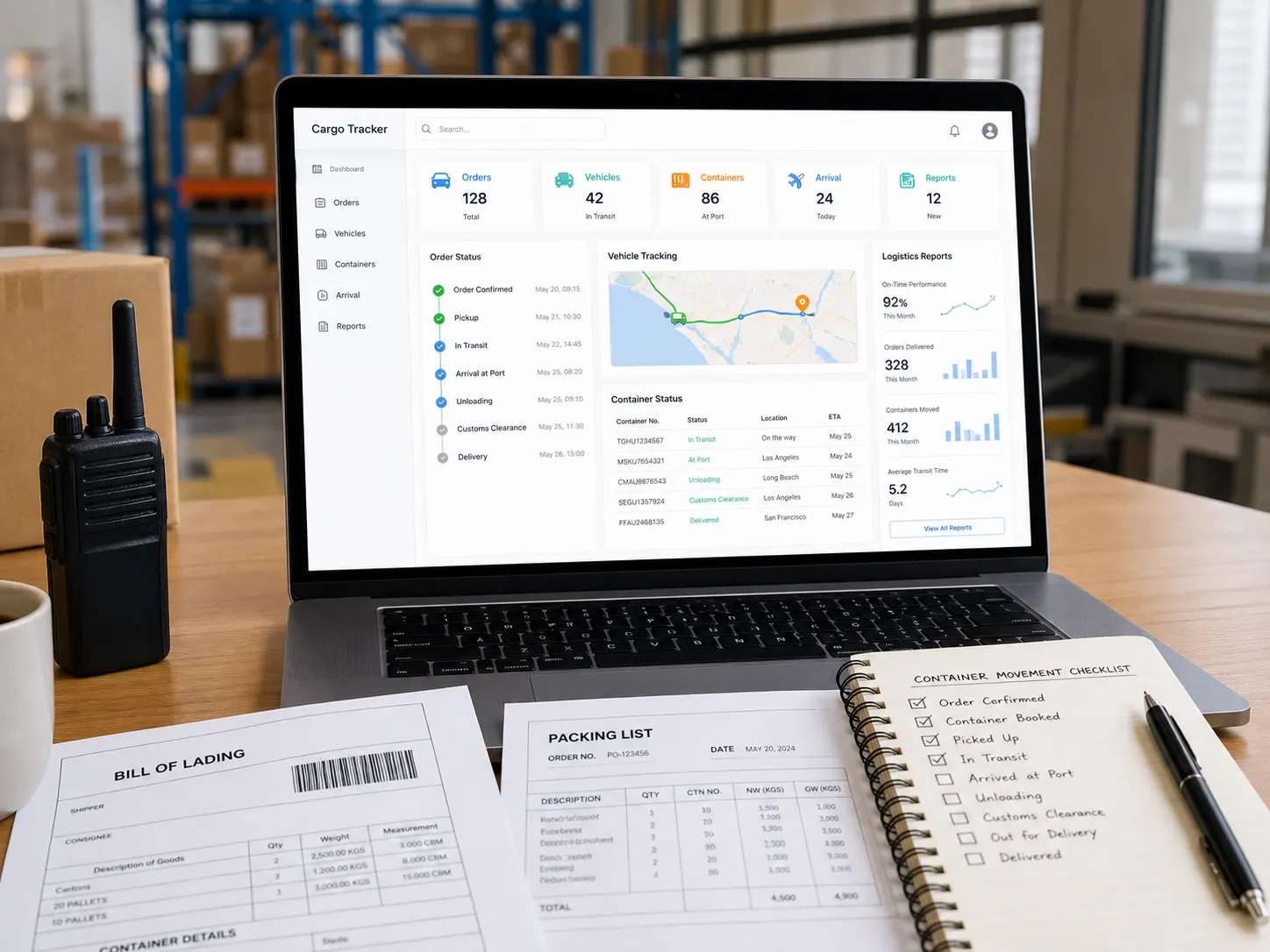
Centralized visibility into cargo received, pending quantities, unloading activities and shipment readiness.
Warehouse users can record operational activities directly from mobile devices and capture supporting photographic evidence.
Current order and cargo information provides calculated inputs for more efficient container planning.
Flexible workflows support different combinations of customer orders, cargo and containers.
Customers can securely access the latest status of their own orders without depending entirely on manual updates.
Cargo against an order may arrive through multiple vehicles over several days. Warehouse users record arrival details, received quantity, warehouse location and supporting photographs.
Warehouse teams can capture arrivals, update unloading, record quantities, take photographs and update status directly from the location where activity takes place.
Warehouse and godown information helps teams understand not only whether cargo has arrived, but also where it is physically available.
Users can review ordered quantity, quantity received, quantity unloaded and quantity pending without manually reconciling multiple records.
The application uses order, cargo, received, pending and shipment requirement data to present calculated inputs for container planning.
The workflow supports real freight combinations where one container may include cargo from multiple orders or customers.
More than 100 customers can log in and view relevant order and shipment information through role-based access.
Daily email updates keep customers informed proactively while reducing repetitive communication for the operations team.
Back-office and management users can review orders, received cargo, pending quantities, unloading, warehouse location, container planning and shipment status.
Container planning is one of the important decision-support capabilities of the platform. The application uses order, cargo quantity, received quantity, pending quantity and shipment requirement information to help operations teams plan container needs more efficiently.
Freight operations do not always follow a simple one-order-to-one-container structure. The stuffing workflow supports real-world combinations across customers, orders, products, warehouses, containers and cargo.
Thinkinno's contribution went beyond developing a set of screens. The team connected logistics workflow understanding, mobile-first warehouse usability, planning calculations, customer transparency and operational traceability into one live platform.
The platform was designed around the client's actual operational journey rather than treating orders, warehouses, containers and customer communication as isolated functions.
Mobile-first warehouse interfaces allow users to capture information directly from operational locations instead of depending on desktop-only workflows.
Thinkinno incorporated calculations that help operations teams evaluate container requirements using actual order and cargo information.
The system handles real-world combinations of multiple customers, orders, cargo and containers rather than forcing a simplified one-to-one model.
A customer portal and automated daily email updates reduce routine status follow-up while giving clients better visibility.
Photo capture with relevant date, time and location information adds evidence to cargo-arrival and unloading activities.
Orders, customers, vendors, vehicles, warehouses, containers and cargo activities are maintained within one connected system.
Operations teams can quickly determine what has arrived, what has been unloaded and what remains pending.
Consolidated order and cargo information helps teams identify which shipments are approaching readiness.
System-generated calculations help operational teams plan container requirements and bookings more effectively.
Flexible cargo-to-container relationships support actual freight-forwarding requirements.
Users can identify where cargo is physically available across more than 10 warehouses.
More than 100 customers can access information relating to their own orders through a dedicated portal.
Automated daily emails keep customers informed without requiring repeated manual status updates.
The live platform has supported more than 1,000 orders during approximately five years of operational use.
Freight and logistics businesses depend on orders, warehouses, vehicles, containers, vendors, operational teams and customers working together. Thinkinno helps cargo, freight-forwarding and logistics companies build connected platforms that improve visibility, planning, control and customer communication.