
Will versions
Generated and retained through the platform
A security-first wealth-management platform enabling privileged banking customers to create, update, version and securely generate legally structured wills.
Thinkinno designed and delivered a secure digital platform combining estate-planning workflows, personal-law-based business rules, multi-layer data protection, role-based access, auditability, document generation and long-term version management.
Generated and retained through the platform
Supported across India
Including enhancement, maintenance and support
For selected privileged banking customers
Reviewed by bank and independent third-party teams
The bank wanted to strengthen its wealth-management proposition by offering selected privileged account holders a service beyond conventional deposits, investments and banking products.
Will Management was identified as a differentiated value-added service. It helped deepen customer engagement while addressing an important estate-planning need that many customers traditionally postponed or handled entirely through manual legal processes.
Provide privileged customers with a secure, guided digital process to create and maintain a will as an ongoing part of their wealth-management relationship with the bank.
The application would contain exceptionally sensitive information, including personal details, family relationships, beneficiaries, executors, guardians, financial holdings, properties, inheritance instructions and the full contents of a customer's will.
The platform guides customers through estate data, relevant people, asset allocation, validated business rules, secure document generation and ongoing will maintenance.
Customers record personal details, family relationships, beneficiaries, executors, guardians and estate information.
Movable and immovable assets are organized across houses, land, vehicles, accounts, deposits, mutual funds, stocks, investments and other holdings.
Customers define percentage-based allocations for applicable assets, with validations for completeness and logical consistency.
Bank-validated business rules guide will generation for supported personal-law profiles rather than relying on one generic template.
Completed wills are generated as password-protected PDFs using user-managed password policies.
Customers can update wills, generate new versions, download earlier versions and retain date, time and audit information.
The application is primarily customer-facing. Authorized Relationship Managers can also access the application on behalf of customers when assistance is required, while a separate Webmaster/Admin area supports operational and governance functions.
Customers can record movable and immovable assets across multiple asset classes before defining beneficiaries and percentage-based bequests.
Business validations help ensure that allocation information is complete and logically consistent before the will is generated.
Confidential bank and customer information should remain masked. One or two anonymized product screenshots are sufficient, supported by designed blocks for security, lifecycle and architecture.
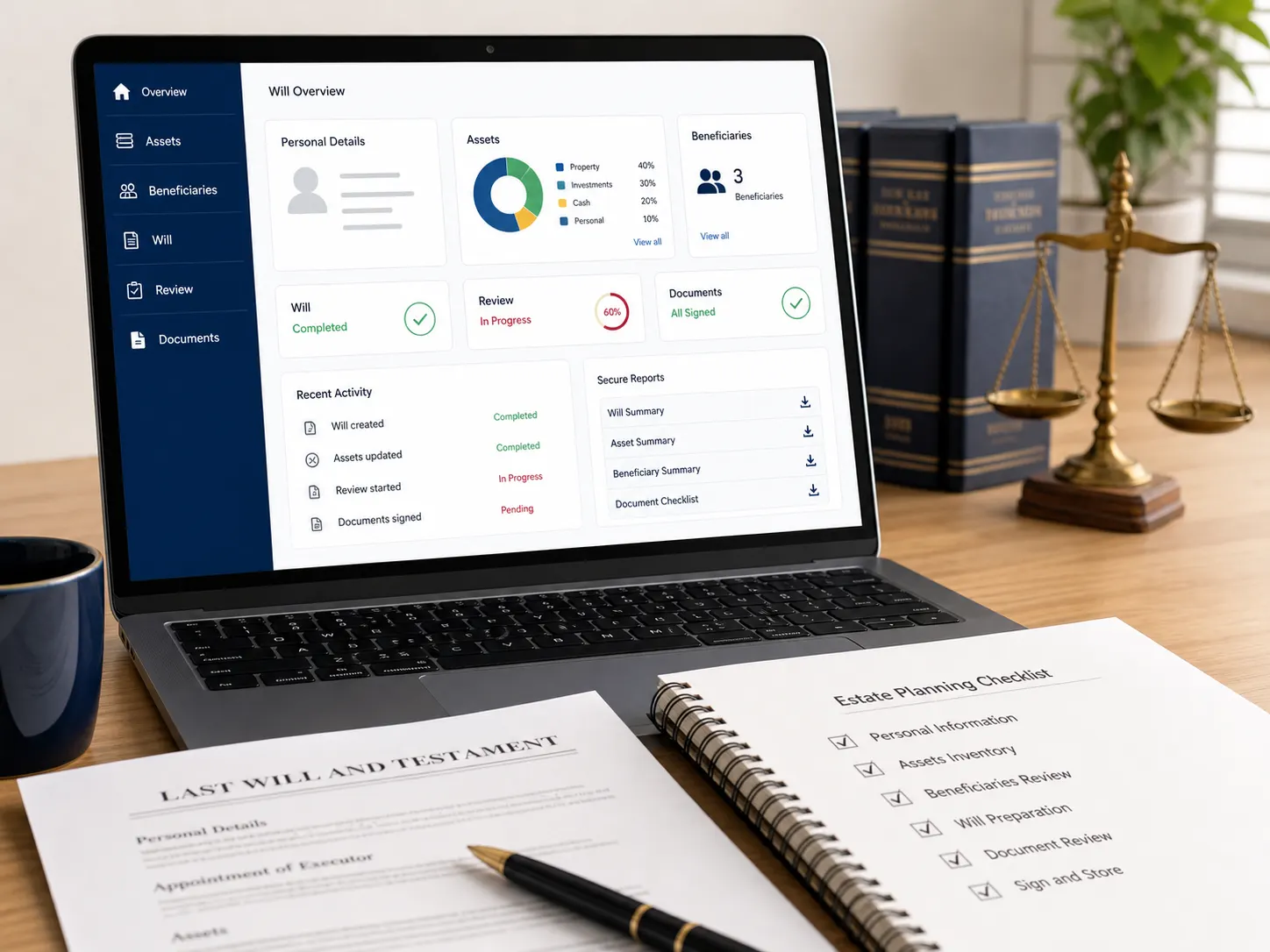
An anonymized view of the customer-facing workflow and administrative platform experience.
Designed content blocks can communicate encryption, role-based access, OTP/2FA, audit trails and VAPT validation without exposing implementation-sensitive details.
Create, update, version, retrieve and securely generate password-protected PDF wills over time.
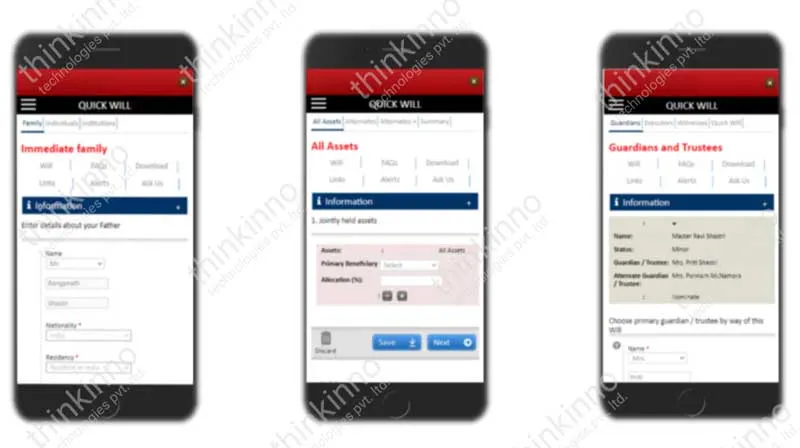
Reusable database, API, middle-tier and business-logic layers reduced mobile extension effort.
Will generation in India cannot always be represented through one universal document template. The applicable structure and rules may differ according to the customer's personal-law profile and religion.
Thinkinno's business analyst with legal expertise helped define the relevant business rules. These rules were reviewed and validated by the bank before implementation, then translated into the software workflow and document-generation logic.
Thinkinno translated client-validated legal and business rules into software logic. The application did not rely on a single generic will template for every customer.
Once the required information, allocations and validations are complete, the platform generates the will as a PDF document. Customers set the PDF password themselves, and the password is subject to configured security policies. This gives customers a portable digital document while maintaining an additional layer of protection around highly confidential estate information.
Minimum password length
Uppercase characters
Lowercase characters
Alphabetic characters
Numeric characters
Special characters
Security was a defining requirement because the platform handles personal, financial and inheritance information that should not be visible without legitimate authorization.
Security control incorporated into the application architecture and operational model.
Security control incorporated into the application architecture and operational model.
Security control incorporated into the application architecture and operational model.
Security control incorporated into the application architecture and operational model.
Security control incorporated into the application architecture and operational model.
Security control incorporated into the application architecture and operational model.
Security control incorporated into the application architecture and operational model.
Security control incorporated into the application architecture and operational model.
Security control incorporated into the application architecture and operational model.
Security control incorporated into the application architecture and operational model.
Because the platform was built for a bank and contained highly confidential customer data, the solution underwent extensive security validation before acceptance and use.
The architecture was designed so essential sensitive will-owner information was not visible to unauthorized personnel, including members of the development team.
The platform was originally developed as a web application. Later, the bank wanted the same service inside its existing mobile application. Reusable data, API, middle-tier and business logic layers reduced redevelopment effort and helped keep rules consistent across channels. The main adaptation was concentrated around the mobile user interface rather than rebuilding the complete application.
Database layer
Middle-tier components
APIs
Business logic
Significant JavaScript functionality
Existing validations and application rules
Significantly lower redevelopment effort
Less duplication of business logic
Reduced regression-testing effort
Lower overall implementation effort
Faster extension to the mobile channel
Lower risk of inconsistent business rules between web and mobile experiences
Thinkinno helped convert a sensitive wealth-management concept into a secure, governed, customer-facing banking application with validated domain rules, lifecycle versioning, security controls, auditability and mobile-channel reuse.
Thinkinno contributed business analysis, legal-domain rule translation, secure architecture, UI/UX, development, PDF generation, QA, deployment, remediation and 6+ years of support.
Thinkinno helped transform Will Management into a structured customer-facing banking application covering estate data, beneficiaries, allocations, document generation, version management, security, controls and auditability.
Business analysis and legal-domain expertise helped define personal-law-specific rules and translate bank-validated rules into software workflows.
Encryption, authorization, OTP/2FA, restricted visibility, audit controls and security validation were incorporated as core requirements.
Versioning, audit trails, updates and retrieval of earlier versions were built in because a will evolves with the customer's estate.
The original architecture enabled the bank to extend Will Management into its mobile application while reusing core layers and logic.
Thinkinno handled business analysis, architecture, UI/UX, database design, development, security implementation, PDF generation, QA, deployment, remediation and long-term support.
The bank introduced Will Management as an uncommon value-added service for selected privileged account holders.
Customers gained a structured digital option for creating a will instead of depending entirely on manual processes.
A guided digital experience made will creation more accessible for customers who might otherwise postpone estate planning.
Customers can update wills as assets, investments, beneficiaries and personal circumstances change while retaining previous versions.
Multi-layer security, encryption, access controls and security validation protect confidential personal and estate information.
Version history, audit trails and audit reports provide visibility into important changes and system activities.
Customers can download password-protected PDF wills using passwords that comply with defined security policies.
Reusable architecture reduced the development, duplicate logic and testing effort required for mobile integration.
The platform has a 6+ year application history and has generated 5,000+ will versions.
Financial applications handling confidential customer information require more than functional development. Security, complex business rules, user experience, auditability and long-term architectural flexibility need to be considered from the beginning.